
Ruins of the Old Web - Volume 5
11/11/2026
V4.3 - October, 1996
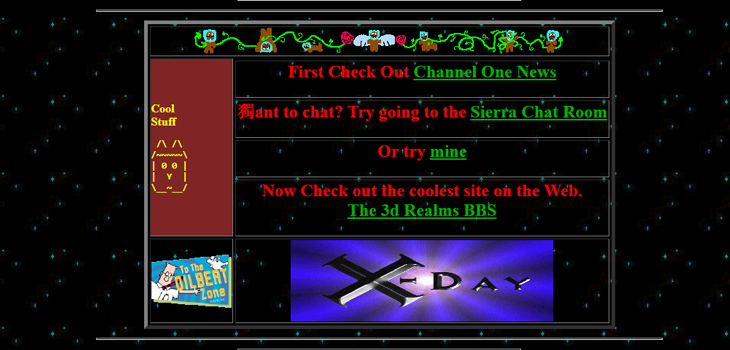
Here we begin our somber march away from friends and family and into the nihilistic online world of gaming and communities. Well, community wouldn't begin for another year or so, but there's a sharp decline in crossover content from the offline world and a rise of things that only the internet could foster.
I suppose in some small way, the internet was continuing the BBS days, which were very much grounded in the real world, despite their digital and decentralized nature. In that, I mean that my friend's brother had this modem thing and could get games and raytraced .PCX files of chessboards and tigers, so we still needed the human effort of swapping floppy disks after church on Sunday. But now I was the one with the modem, and the home pages for each developer could offer the same shareware files. My dad was convinced I was going to load the family computer with virii no matter how much I argued that I was getting them from the source, and I highly doubted 3D Realms was going to infect their own games.
I guess that's why part of the oldweb nostalgia is a bit mixed for me. It's not really the web that I'm looking back fondly upon, but those very early days where it was something communal that the whole family got involved with.
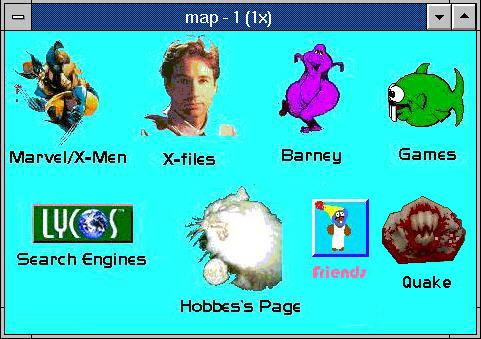
Okay, enough emotion-baiting. This version of the site by the Fall of 1996 hadn't changed too much. In fact, when I archived the fragments a few years ago into new hosted versions, many of the sub-pages link to the June copies, so the only new content is going to be on the index and the quake page. I also tried my hand at this new-fangled image map technology by making a pseudo-Windows 3.11 screen of icons. You thought we were all trying to replicate that in 2020, but no… by 1996 we hated Win95 enough to look back at the better days of 3.x.
Enough chatting; let's see what remains of the ruins from Oct 1996:
Quake Stomping Grounds
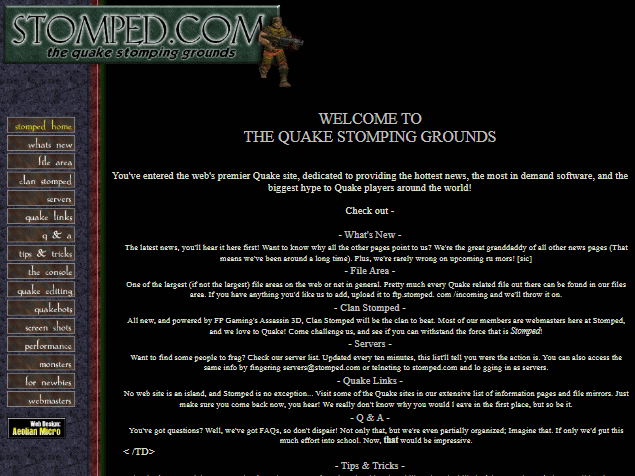
I was relatively thrilled to see such a complete version of Stomped.com, especially with the image menu (because that will totally not be annoying to update down the line). Later versions moved to a sleeker design with a chic logo and a whole lot of blue, but I love the old school ethos in play with this early design.
The image menus are one thing, but the non-tiling background was another feat. Nowadays, we can set the CSS to limit the x-axis repetition. In those days, you just made an insanely long image so it spilled off the screen. How insanely big? Well, 1249 pixels here seems to do the trick. Monitors were 640-800 px as the norm, and a few crazy people had 1200. Tack on a few pixels as a buffer, and it's future-proof.
And bless them for that trailing and broken </TD> table tag. It shows that they were using notepad instead of FrontPage like real men.
The Monster and Tips sections are still there, and they're worth a read for the era-specific insight. I see that Redwood was a contributor before he had his own site. Redwoord, Blue's News, and sCary's hugashack were my go-to sites moving forward, so it's fun to see where he started. I'll have to see if Quakeholio is still around to see where sCary started.
They got sponsored by IGN, turned into game culture rather than Qauke, and then later tried to rekindle the indie gamer spirit. Since they're no longer around, I can only hope they are doing well nowadays.
THRED - The Quake Editor
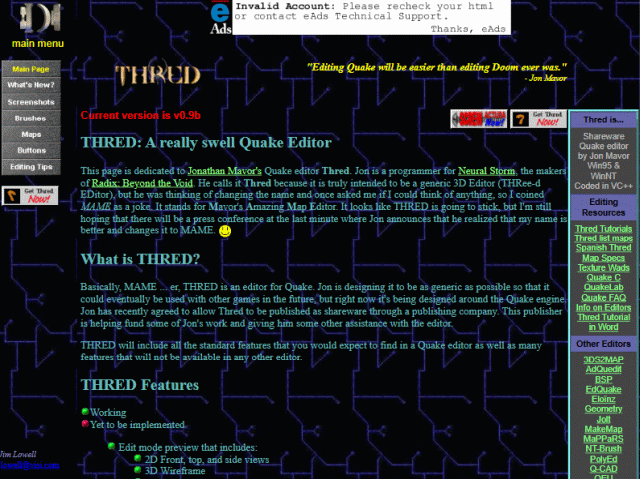
I was a late bloomer into the map-editing craze of FPS Doom clones. Rise of the Triad was easy enough since levels were just made up of grids/tiles, and level editors for Doom didn't mature until well after people stopped… then started playing it again. Quake was another beast with its fully 3D brush-based maps. We went from tiles to top-down vectors to having to basically carve a level out of primitive shapes.
Thred (aka THRee-d EDitor) was a very early entry into the attempts at trying to make something in this new format. No longer could you just pull a map into something and see how it was made. No, you had to create a .map file of coordinates, then bake it into a Binary Space Partition. bsp file, then run a light pass, and then a VIS pass, assuming you didn't have any leaks. You always did, so after waiting 40 minutes for that third step to run and ultimately fail, you told yourself that it wasn't really needed. The level still loaded, so efficiency can take a hike. Who needed that? I had a Pentium Pro running at 200 MHz, and my rival at school only had 180 MHz, so suck it, CEEE JAAAY.
If you've seen my pyramid level on the Quake page here, you've seen the handiwork of Thred. I had another before that, but it's lost to time, which is for the best. Later on Worldcraft took the crown, and Thred sort of threw in the towel by '98 after not releasing an update since late '96.
It still has a place in my heart, and I recall learning about concave brushes off their page, which is thankfully still there.
The Shambler's Lair - A Quake Page
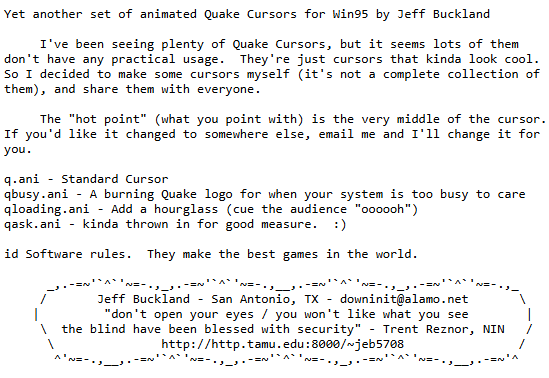
Alas, alas, we hit a dead end. The page doesn't show up on Wayback, and a Google search of the raw URL doesn't show any archives or newsgroup mentions. We do, however, have some custom work by the author. And since every mod on idgames has an accompanying .txt file, we can still access some of that.
Modding cursors to customize your Windows experience was fairly routine. A few more years, and I'd be decking it out in Southpark themes, but for the time being, a Quake logo attached to my mouse pointer was good enough. I've hotlinked the .zip file below if you want to check it out. It's been up for 30 years now, so surely now that I've referenced it, the host will go kaput.
Mr.DooM's Quake Page
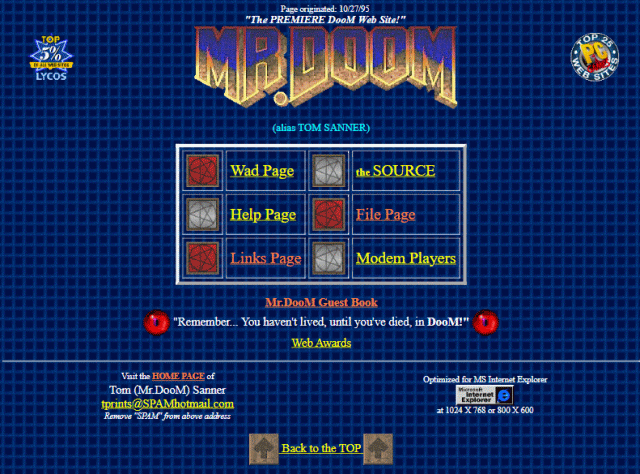
We almost had two strikes in a row. A ~mrdoom directly hanging off an Erie domain redirected to a bookmark update page. That led to a new subdomain on the same site, which was his new general page, and then from there you could get back to the Quake one. But despite the bouncing around, we were still left with a page of broken images and dreams. No amount of digging could find a page with more than an icon that survived.
My backup in these cases is to search for either the full page title or the URL. The URL didn't pan out, but the page name came up as the first entry and looked promising. Clicking on the link presented the exact page I had been looking at but in full graphics. I think this was what it was like for audiences to see the Land of Oz come to life back in the silver screen days.
And I'm so happy someone (if not the original author) archived this. I feel like it must have been recently, since geocities.ws is sort of yet another oldweb revival host. We have the medal icons boasting the best of the web. We have random icons surrounding text, links, and titles. We have full legal names and e-mails right out in the open. This is the wave 2 aesthetic perfected, and a timecapsule of what 1996 could offer.
Just a word of caution, though. I've linked to the rehost in the main section above, but the wayback in the ones below. Geocities.ws does insert ads, and on my phone, it was attempting some redirects, so I don't 100% trust it. It may be best to use yet another layer of the Wayback on the rehosting, just so anything dodgy is stripped out.
QuakeSpy

Quake was never solely a single-player game, but unless you had a local network, playing your friends wasn't the easiest task. I almost got Rise of the Triad working once, and I never played deathmatch Doom, but once Quake promised a bit more. With some refined and predictive networking code, it was almost possible over modem. Almost.
But then you needed to find open games, since there was no lobby to speak of. Enter QSpy/QuakeSpy. It would become more generic in time as more shooters entered, being relabeled GameSpy after not too long. That's the main reason there isn't much to look at on the panix.com host. By 1997, the content had been reduced to redirects, leading to proper domains as the domain.tld/~username format drew heavy lines in the online caste system.
But certainly, there must be something, so I drilled down to the root and found yet another basic 'go away' page. But something stood out. A link promised the main quake page, which then redirected again to another directory. That in turn went to a proper domain as customs dictated. It was just the name that intrigued me: Blue's Quake Rag.
In the first entry, I mentioned that Redwood, Blue's News, and sCary were the three main gaming news sites, and finding the origins was something of interest. Did I stumble on Blue's origins?
I did! I know I'm not along, and anyone who went to the QuakeSpy page in the day would have known that, but it was still amusing, nevertheless. I had to keep digging since I wasn't getting any real content. A listing of the open '3d/' folder gave me a directory listing, which presented was a 'bros-gibs' sub-directory.
Clicking on that gave me something wonderful.
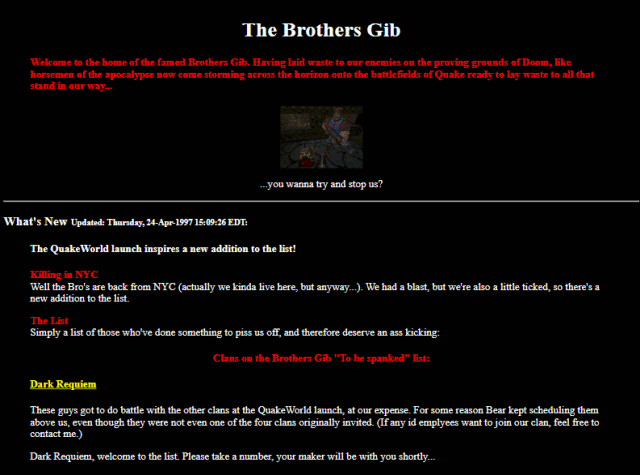
I'm guessing it's a Clan of sorts before I had any idea what those were. I'd be another year before I really delved into the gaming community, but I guess I was still pretty late to the party, even by late-90s standards.
Now I really need to track down Quakeholio.
The Dilbert Zone
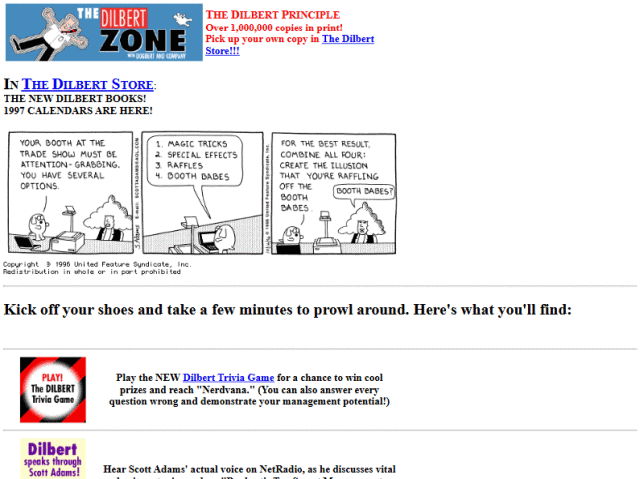
It's no hyperbole that Dilvbert shaped my professional life. Before I entered the workplace, I read the daily comics, I bought the compilation books, I played the Avoid the 'Noid clone, and I read Dogbert's guide to surviving at a job. Combine that with Office Space, and the more you treated an office job like a game that didn't make sense, the better you did.
For example: You ran out of things to do, but you can't look idle.
Solution: grab a clipboard and walk around looking like you're trying to figure something out. Don't make eyecontact, since the random piece of paper in front of you is your sole priority, even though it's nonsense.
I'd do this every half hour or so. My first job was so dreadfully boring, since there certainly wasn't 8 hours worth of computer junk to do in a small company. There were pet projects on the web, like what I'm doing now on company time, but still—it was a lot of dead air.
Sadly Scott Adams passed away shortly after falling to cancel culture for making his usual brand of politically incorrect, yet honest, remarks. Had anyone actually read through the Dilbert catalog, especially the annotated ones, it would be plain to see his disdain for being strongarmed into apologies.
I'm sure there are archives out there to still see the panels, but this main site cut the cord a while back, so no dice there.
MIDI.com
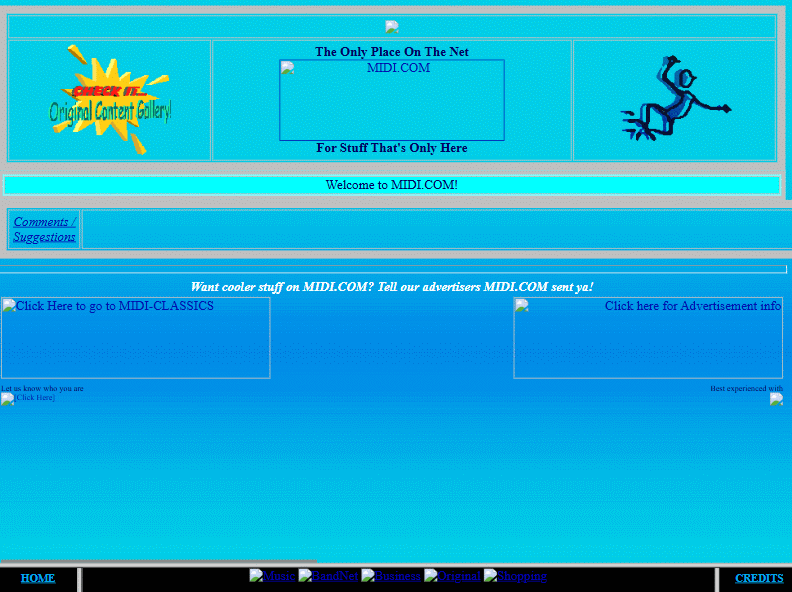
According to the journal that I began only that prior August, I didn't download my first MP3 until early in 1997. Internet radio was a ways off (I think), and stuff like iWave and real media were kicking around. But the quality/size tradeoff was steep. MP3s sounded great, but 1 MB/minute of audio over a 56K modem wasn't going to net you too much. And the heavily compressed internet audio formats sounded like you used a laundry dryer to channel the music.
But there was an alternative: MIDI. It just recorded the notes and used the system's sound library to turn the notes into instruments. Truth be told, it was sort of old-tech in our eyes at the time. Even since the early 90s, I had been getting MOD/tracker music off the aforementioned BBS, which did something similar—but had its own instruments, so you could vary the sound quite a bit, and even use samples. Ever heard Zombie Nation by Kernkraft 400? That's tracker music, and it was an anthem for about a year, so no small stuff.
So why did MIDI pop back up, outside peopleusing it for its actual intended purpose? Well, you could embed them into webpages and have them auto-play. Everyone loved that! So, we had a different one play for each page. MIDI.com was the solution to finding the exact track you wanted, so it was a necessary tool in your kit.
LPage

I forgot to mention that we moved off the gamesoage, but I imagine you probably gathered that. You're so smart. The next volume of this series will be solely based on 88×31 (aka NOW!) buttons, and we're dipping our toes in early with these last few.
For the first few years of the web, you had to live and die by the static content you added. If something wasn't in your source code, then it wasn't showing up on the page. Eventually we endured the nightmare that was CGI-BIN/PERL and could run things on the server. I only marginally understood what was going on, so I hacked together a guestbook by appending a table block to the bottom of another .html page, and that seemed to do the trick. It wasn't pretty, though, and the XHTML purists of 2006 would slaughter me for ignoring that final </html> tag so I could just keep glueing on inane comments from strangers.
Luckily, smarter people out there existed for a short while. It was the internet, after all. Only the top of the top was on it. They were altruistic too and provided things like hit counters and guestbooks for free! It was a halcyonic intermediate time when some additional functionality was present, but the capability of malware wasn't. We had it all.
Despite linking to the page, I don't recall using them, since my hacked guestbooks persisted for quite some time, even into my half-life days years later. Ah well, there's your small history lesson anyway.
Well, there we go. I suppose it wasn't as somber as I had thought. 1998/1999 will be much worse, but in real life, I did finally start making friends in highschool, so my offline life took a decent upswing for a year. Still, expect more games and little else in Volume 6—maybe a few Barney pages as remnants of what once was.